
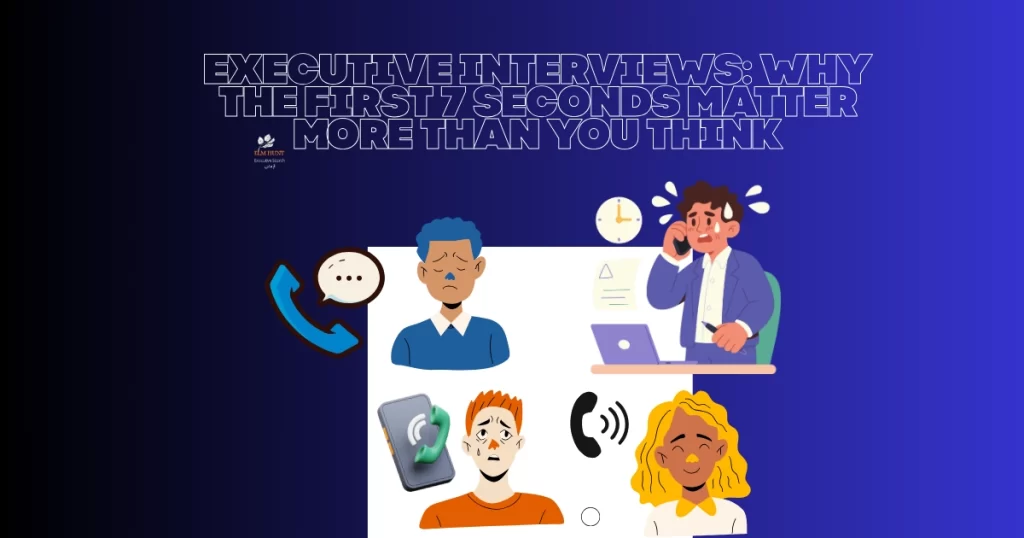
Why the First 7 Seconds Matter More Than You Think!
In executive interviews, first impressions are formed immediately, faster than most leaders realise.
Before being wowed by your experience, credentials, or track record and before these are explored, something more subtle and invisible is already at work — your tone, presence, and emotional signal. During board-level and C-suite interviews, this ”initial moment” is what often shapes how the entire conversation is interpreted and how your interview flows.
Failing to Realise: Executive Interviews Are Judgement Moments and Not Just an Opportunity to Show Case your Experience and Expertism
Whether the interaction takes place in person, online or over the phone, senior interviewers are constantly assessing more than your words and reading between the lines. At executive level, interviews are not transactional conversations. They are judgement moments — moments where leadership presence, emotional intelligence, and clarity are evaluated in real time. Within the window of the first few seconds, listeners are instinctively assessing you for attributes such as:
- Confidence and composure
- Emotional balance
- Clarity of thought
- Authenticity
- And a ”Value Asset” to the company
This process is unconscious, but deliberate and very powerful.
Controlling Your Voice and Emotional Signal and the Role this plays During an Interview
On a phone call or over a virtual online call or online interview, your voice becomes the primary signal. The psychology of your voice reveals many aspects about you, including your emotions, personality, and your mental state of mind. Your voice is projecting a glimpse into your inner world like an open window into your mental phyche, energy, pitch, tone. Speed signals confidence, anxiety, or authority and your listeners are processing every sound you make to communicate, even before words are processed.
Your voice reflects subconsciously how you are feeling, for instance, are you feeling tension from anxiety or openness when at ease? Are you influenced by past experiences, self-perception, and social factors? How do you use your voice? To form connections or disconnection? All ot these aspects depend on your vocal choices like loudness, tone, cadence and pace.
During the interview the interviewer is not just hearing about your experience and achievements but is processing your content tone and communicates intent. Ask yourself, are you Calm, positive vocal or defensive and unenthusiastic with a flat tone?
Energy signals leadership stability. Whereas tension, defensiveness, or flat delivery can quietly undermine even strong credentials. Research in behavioural psychology confirms that emotional cues in voice influence trust, engagement, and perceived competence — long before factual detail is considered.
Why the Phychology of a Smile Changes the Outcome
A smile may seem trivial, but it has measurable impact. Smiling — even intentionally — activates facial muscles that influence emotional processing in the brain. This affects how a speaker sounds, how they think, and how they are perceived. Listeners can detect a smiling tone without seeing the speaker. It subtly improves:
- Warmth and approachability
- Trust and engagement
- Conversational flow
At senior levels, where trust and judgement matter more than performance theatrics, this matters.
What Boards and Senior Interviewers Listen For
Experienced interviewers are not simply listening for answers. They are listening for signals. Through tone and delivery, they assess whether a leader:
- Remains composed under pressure
- Communicates with intention
- Builds rapport naturally
- Demonstrates emotional intelligence
A positive, balanced vocal presence helps establish credibility before deeper evaluation begins.
Making the First Moments Count
During your executive interviews, the goal is not to impress — it is to create alignment. A calm, confident opening sets the tone for strategic discussion. It signals leadership maturity and readiness for responsibility.
Regardless of outcome, strong leaders leave interviewers with a clear impression: clarity, professionalism, and presence even if they are not offered a role – but they leave a positive lasting impression that will be etched in the interviewer’s memory. And sometimes, that begins with starting with a simple — yet powerful — attitude and mood-setting smile.
Elm Hunt Executive Search
1 thought on “Executive Interviews: Why The First 7 Seconds Matter”